Gaussian haze vs edge-aware softness
Blind blur spreads radially. Guided feathering bends around the plate.
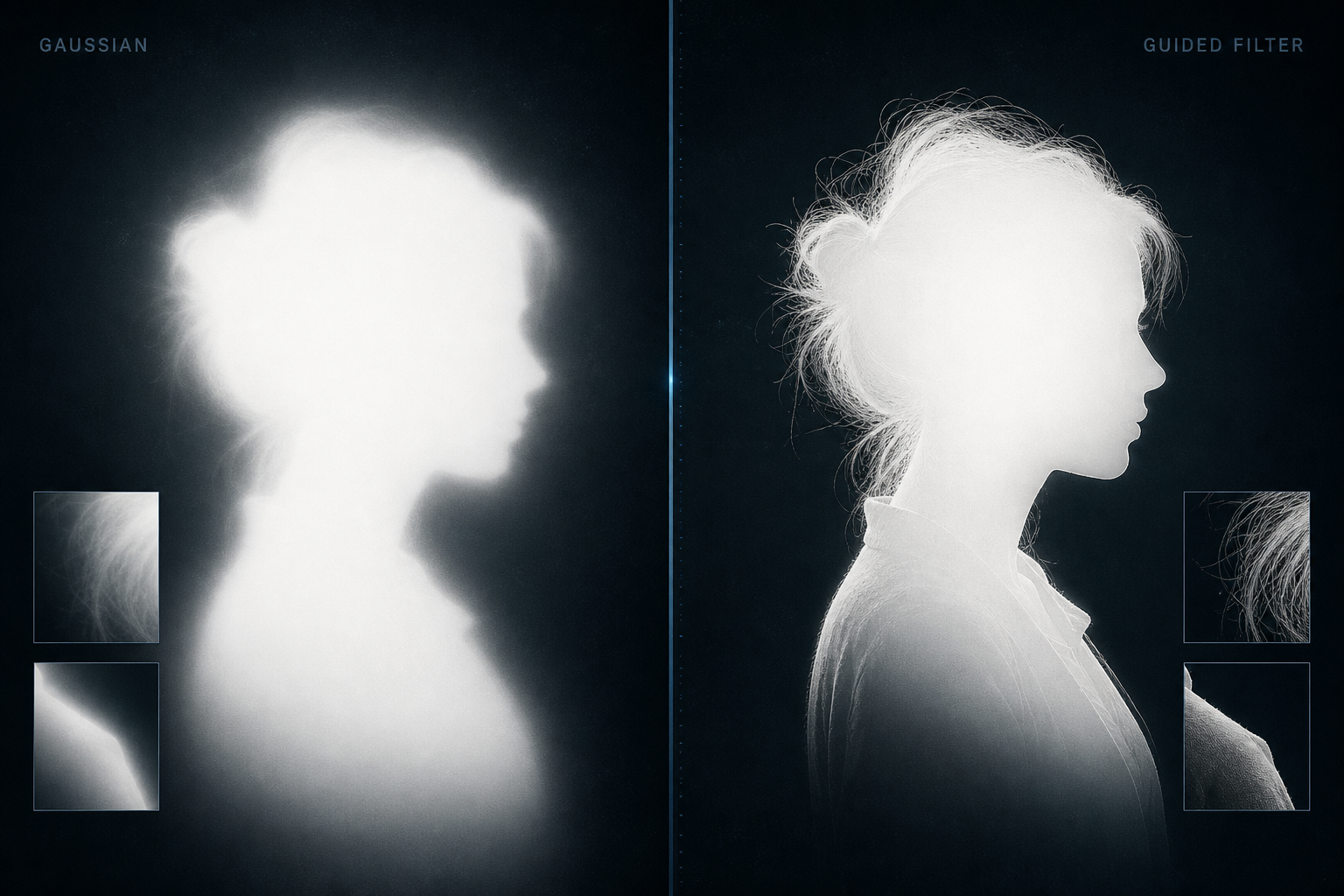
Soft mattes that respect edges. Transduce feathers with a guided filter — the same edge-preserving family used in other leading software packages — so softness follows real detail instead of a blind Gaussian haze.
Most grading tools still soften a qualifier with a plain blur: every pixel gets the same falloff, whether or not there is hair, fabric weave, or a hard contrast edge underneath. That is fine for a soft vignette. It is wrong for a skin matte that has to stop at frizz, or a sky key that has to cling to a boom-mic silhouette.
Transduce replaces that last-stage blur with a guided filter driven by the frame’s own luminance. The algorithm softens where the image is flat, and tracks structure where the guide has real variance — standard technique, production-grade behaviour.
Blind blur spreads radially. Guided feathering bends around the plate.
Guided image filtering (He, Sun & Tang — ECCV 2010 / TPAMI) is not a Transduce invention. It is a published edge-preserving filter with a linear-time path — the same class of technique used in other leading software packages for guided feathering and edge-aware matte refine.
| How it shows up | |
|---|---|
| Other leading software packages | Edge-aware / guided feather controls that soften a matte while following structure in a guidance image |
| Transduce | Built into the qualifier refine stack as the default feather — guide = frame luminance, no extra node graph required |
We cite the technique honestly: matching what colourists and compositors already trust elsewhere — not claiming we own the paper.
Inside the Mask panel’s refine column — after the selection is made, before intensity and invert.
| Detail | Behaviour |
|---|---|
| Guide image | Per-frame luminance from the source — already available in the qualifier path, no second render pass |
| What softens | The matte only — colour grade stays on whatever the selection encloses |
| Edge behaviour | High local variance in the guide preserves structure (hair, fabric, hard lines); flat regions blur smoothly |
| Implementation | Standard He et al. linear model from box filters — no proprietary ML, no optional image-processing addon required |
| Fallback | If a guide frame is not available to a caller, feather falls back to Gaussian so the control never silently no-ops |
| Order reason | Expand/contract runs before feather — closes noise-driven micro-holes while the matte is still hard-edged; guided feather then softens one clean boundary instead of fogging hundreds of speckles |
Qualifier + guided feather is computed fresh from pixels every frame — no learned segmentation, no matte flicker from a model that drifts shot to shot. That temporal stability is the point of the masking engine on DNA-06; this page is the soft-edge half of that story.
Note: geometric shape soft-edge uses a distance ramp (straight falloff on the shape boundary), not the guided filter. Guided feathering applies to the qualifier matte refine path.
Industry-standard guided filtering — wired into the qualifier so hairlines stay hairlines.